Why does AI writing sound like AI?
You have probably had a feeling that what you were reading was written by an AI. You cannot say why. It reads fine, the grammar is right, but you are fairly sure a person did not write it. Why is your gut telling you this? What are the cues you are picking up on? And how do you use AI to help with your own writing without tripping the same icky feeling you get from everybody else's?
It is complicated.
People pick up on patterns that feel fake, by instinct, without being taught how. The reaction that follows is visceral. Recognizing machine writing reads as an insult, and people respond in kind. Why am I putting more time into reading this than the author spent writing it? Is any of this even true, or did the model hallucinate again?
Reading is competing with TikTok now. When somebody decides to spend the effort on a paragraph, they want to know the effort was matched on the other side. Bullshit posing as work burns through what patience is left.
This site is about the tells: the fingerprints of machine-written prose. Looking for research on them turned up dozens of articles, tools, subreddits, acceptable use policies, and YouTube comments, and almost everywhere people discuss writing online somebody is complaining about AI slop.
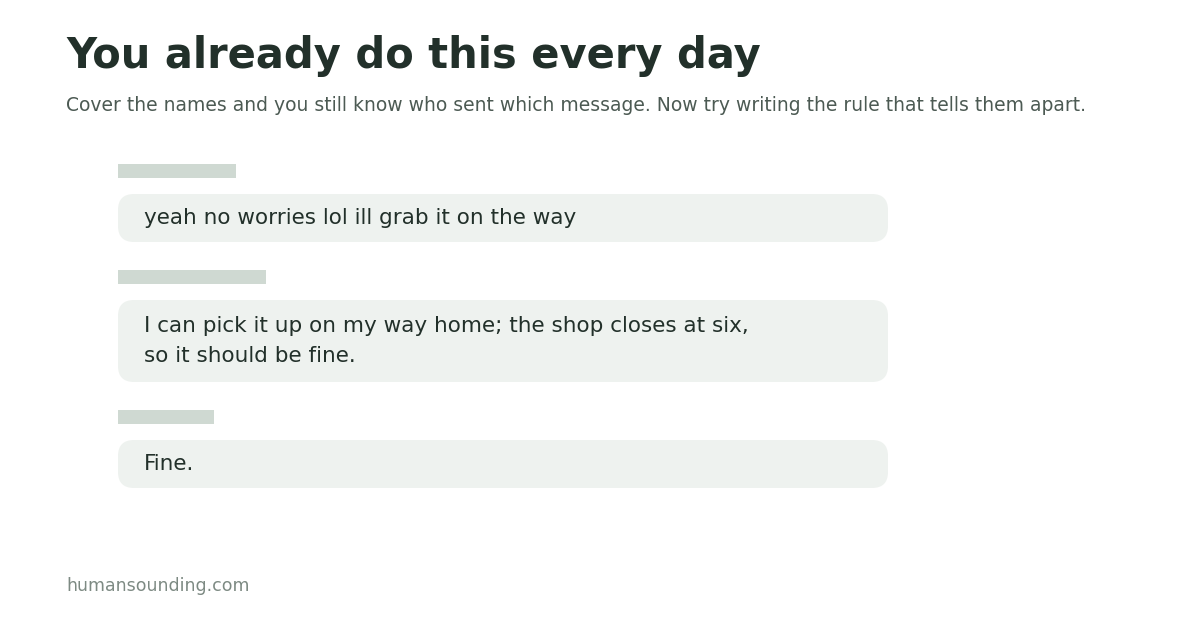
You already do this with text messages
Cover the names on your phone, and you can still tell which friend sent which message. One of them never uses capitals. One writes in full paragraphs, with semicolons. One answers everything with a single word and a period, which always reads as anger and never is.
Now try to write a rule that defines each friend's texting habits. It is harder than it should be, and every habit you manage to name turns out to be useless on its own. Millions of people skip capitals. The lowercase is not the evidence.
You were right anyway, because you were never using one clue. You were reading thirty at once, weighing them against each other, and none of it went through the part of your brain that makes sentences.
Machine writing has the same kind of fingerprint. You are reading it the same way.
What the fingerprint is made of
I have been cataloging these habits for a few weeks, and after measuring a few hundred thousand words, the honest summary is that most of them are small.
The long dash is the one people notice. Claude writes one about every ninety words. In the human articles I measured, it turns up about every two hundred and fifty. That is a real difference, and you can feel it without counting.
Some words got used so hard in 2023 that they now sound like a machine cleared its throat. Delve. Leverage. Showcase. Pivotal. Seamless. Meticulous.
There is a shape where a sentence tells you what something is not before telling you what it is. It's not just a tool, it's a way of thinking. Once you see it you cannot unsee it.
And there is a habit I find more interesting than any of them, which is writing about the writing. A machine that has just been corrected will tell you it was wrong, tell you what it changed, and rate how confident it is, before it gets around to the thing you asked about. People almost never do this. We just fix it and move on.
Why nobody can hand you a test
Here is where it gets awkward for anyone selling certainty.
I have measured fifteen of these habits across four different AI models and two sets of writing published before ChatGPT existed. Of those fifteen, exactly one separates a model from human writing cleanly enough that I would stand behind it on its own. Four of them never occurred at all.
That is what individual clues are like. Any one of them, on its own, is weak, and plenty of people write that way naturally.
There is a second problem, and it is worse than the arithmetic. The em dash has become famous. Enough people have read enough posts about it that a single dash now gets treated as proof, by readers who have never seen a rate and never will. I cannot measure that, but I can watch it happen, and it means the punctuation mark carries more suspicion than the evidence supports. Writers have started removing dashes they wanted, from sentences that were fine, to avoid an accusation nobody has actually made yet.
So if you accuse somebody over one em dash, statistically you would be wrong, and you would be wrong about a real person who wrote a real thing.
There is also what a person brings to a page that a model cannot. You know the reader. You know what happened last week, what the room is like, which joke lands and which one gets you in trouble. Most of the rules you follow when you write were never written down anywhere, and a model working from text alone has no way to reach them. That gap is where the icky feeling comes from, and it is bigger than any list of habits I can measure.
What to do with this instead
Stop trying to catch people. It is a bad use of the skill, and you will hurt somebody eventually.
Use it on your own drafts. If you write with a model, the habits above are the ones that make your work read like everybody else's, and they take about two minutes to strip out. Cut the extra dashes, replace the brochure words with the ones you would actually say, and delete any sentence that is about the writing rather than about the subject.
None of that is a plea for small words. A good vocabulary is a precise one, and the machine words are the opposite of precise. Leverage, showcase, and seamless are not sophisticated, they are what you reach for when you have not yet decided what you mean. Keep every word you chose on purpose, including the long ones.
Sentences about the writing are the hardest to catch in your own draft. Cut one, and if the reader loses no fact about your subject, it was never doing anything.
You can paste a draft into the checker and it will point at the spots. It will not tell you a machine wrote something, because it cannot, and neither can anything else. It tells you where to look. What you meant to say is still your call.
Every number here comes from measuring four AI models against two sets of writing published before ChatGPT existed. The definitions are on the tells page, with the rates under each one, and the corpora and scripts are in study/.